For pharmaceutical and healthcare professionals, decades of hard work and company loyalty often result in a sizable retirement portfolio. However, because of company stock matches, grants, and ESPPs, many high earners in this space unknowingly face a massive financial vulnerability: overconcentration in their employer’s stock. Holding a heavy allocation in a single company or sector can leave your life savings highly exposed to market volatility just as you approach the finish line.
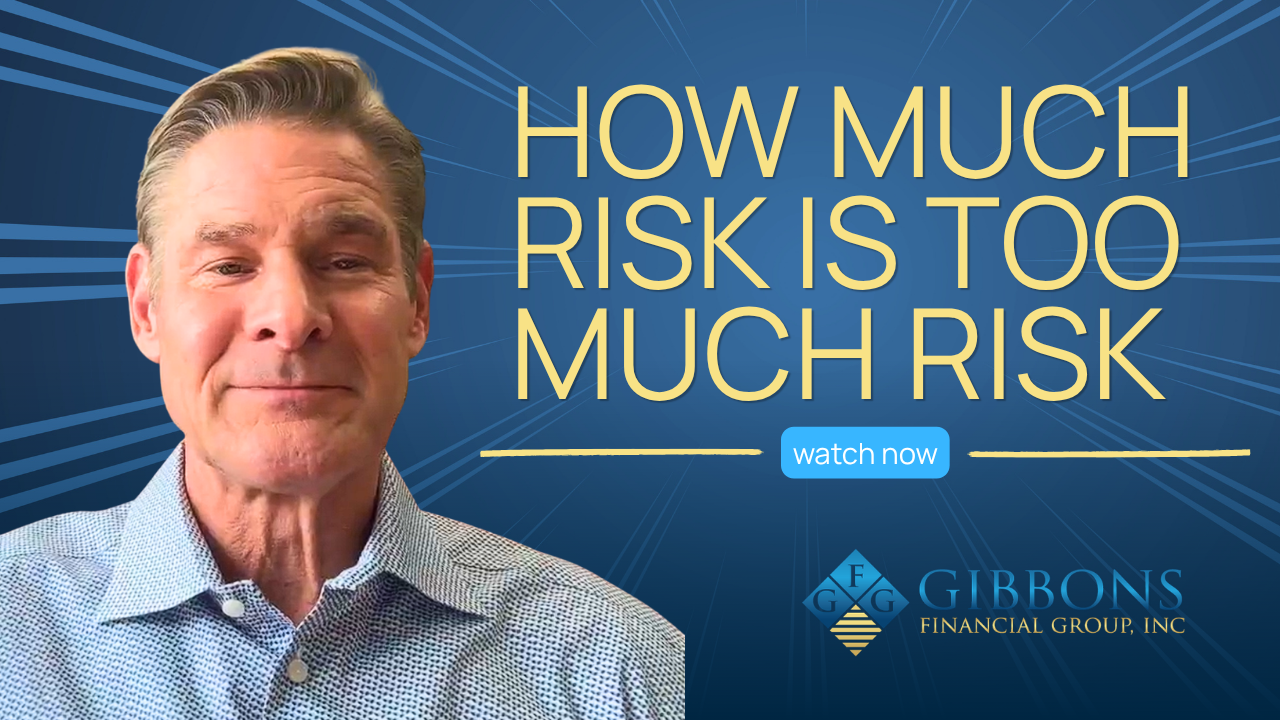
In this short video, Mike Gibbons of Gibbons Financial Group breaks down the practical realities of managing retirement portfolio risk. He explores why a position of more than 10% in employer stock is an immediate red flag, how to use data and analytics to measure your true risk tolerance, and the step-by-step strategies you can implement in the final one to five years before retirement to protect your hard-earned nest egg. Watch now to learn how to transition away from emotional investing and toward a secure, diversified income road map.
Transcript
If you’ve been in the pharmaceutical or healthcare industry for any length of time, you probably have a sizable retirement portfolio by now.
While some risk is unavoidable when looking for growth, you can’t completely rule risk out of the equation or eliminate it entirely. But you can do a lot to control it. The goal is to grow the asset within an acceptable level of risk while also staying within your personal comfort zone.
A question I often get asked: How much risk is too much risk?
As I tell people, you’ll know when the ride gets too bumpy.
I’m Mike Gibbons with Gibbons Financial Group, and today I’ll be going through risk management strategies for mitigating and handling risk within your specific level of acceptance.
Common Investment Risks for Pharma and Healthcare Employees
First, it’s important to understand some of the main risk factors affecting investors in the pharmaceutical space who have access to their own company’s publicly traded stock.
Overconcentration is a big one.
So much of the time when I meet with a client from Abbott, AbbVie, or any of the healthcare companies that are publicly traded, one of the first things we recognize is the overweighting in company stock.
I understand why this happens. It’s the devil that you know versus the one that you don’t. Many people will also say, “Well, it’s all about the dividend.”
But if we can create a path to reduce the market-weighted risk within your portfolio and reduce overexposure to an individual stock while increasing the dividend, wouldn’t that be a prudent move?
Of course, many would say yes. But how?
Employer Stock Concentration and the 10% Red Flag
When looking at your portfolio, if more than 10% of your portfolio is tied to your employer’s stock, that’s a huge red flag.
If you’re invested in any single stock, not just pharma or healthcare, it’s highly likely your portfolio is subjected to specific stock and sector risk.
We must look at how to pare that risk down, especially if you’re in the window of one to five years before retirement.
How to Understand Your Investment Risk Tolerance
We have to determine your specific risk tolerance. How much risk are you comfortable taking?
This is highly personal, and clients don’t know what they don’t know here. To ask them to define a level of risk individually is difficult because they often don’t know the answer.
They don’t understand asset allocation enough, and it’s not their fault. It’s just not their field of expertise.
Your risk tolerance is partially determined by your personal preference, but your age, proximity to retirement, and longevity matter as well.
For instance, if you’re a young professional with decades until retirement, a higher-risk investment strategy may pay off. Higher-risk investments have a greater potential for reward and may be able to weather the market over long periods of time.
Using Portfolio Risk Analysis Before Retirement
We absolutely need to allow specific data and analytics to define your risk based on your current portfolio.
We have to look at this through the lens of software, which we offer here at Gibbons Financial. In fact, for those close to retirement, we can consolidate down within six-month intervals how much you stand to gain or lose within your portfolio.
This is very important for clients who are looking to understand that risk-reward trade-off.
This is a non-negotiable point. You have to do it. I cannot underscore that point enough. It’s very, very important that you understand risk so we don’t end up like those individuals who retired in 2006 and 2007 and didn’t see the financial crisis coming.
It’s always a good idea to discuss your portfolio with your advisor and review how much risk you have. Getting you to understand that risk is also vitally important.
As I previously stated, this needs to be looked at through an analysis tool, which we can provide here at Gibbons Financial. This is the one part that’s non-negotiable. It has to be looked at analytically.
Warning Signs Your Retirement Portfolio May Be Too Risky
If you look at your portfolio almost every day because you’re worried about market fluctuation, that’s a bad sign. You’re probably not getting much sleep.
Another warning sign is having your employer’s stock as the single largest asset within the portfolio.
If you want to retire within five years or fewer and still have 30% to 70% or more concentrated in one stock or a couple of stocks, that probably will jeopardize the health and safety of your portfolio.
The Arithmetic of Loss Near Retirement
It becomes that arithmetic-of-loss question.
If I’m down 10% in a year and I’m getting close to retirement, I’ve got to do 20% next year just to make that back up. That means I need to take more risk, and that’s not what we’re trying to do.
We’re trying to repair that risk over time.
Looking at markets, whether they’re in growth mode or sell-off mode, we have to ask: Am I deciding too quickly to pull the trigger on things that I probably shouldn’t have? Am I overreacting?
We want to take the emotion out of investing.
Portfolio Diversification Strategies for Pharma Professionals
There are several strategies I usually like to suggest to clients who want to lower their overall portfolio risk.
One is diversifying beyond pharma and healthcare and looking to get into other sectors. There are a lot of other sectors that provide growth.
Another is reducing specific equity risk.
We can also look at making decisions inside Roth and tax-deferred accounts, where capital gains are not an issue and we don’t have to worry about capital gains.
Periodic rebalancing as part of ongoing portfolio management is vitally important, and that is something we handle here at Gibbons Financial.
Retirement Planning Before Market Conditions Change
If you’re not having any of this done for you, let’s have a conversation.
We’ve been in these wonderful markets, but things cool off, as everybody knows.
If you’re looking at retirement within a year to five years, we need to strategically align your portfolio with proper allocation. We can provide that here at Gibbons Financial.
If you’d like to discuss your specific situation and truly understand what your specific portfolio risks are, give us a call at 224-419-5550. We’re here in Gurnee, or you can email me at mike@gibbonsfinancialgroup.com.
And be sure to join our free webinar, Retiring Early from Pharma.
Thanks for watching, guys. We look forward to talking to you soon. Have a great day.